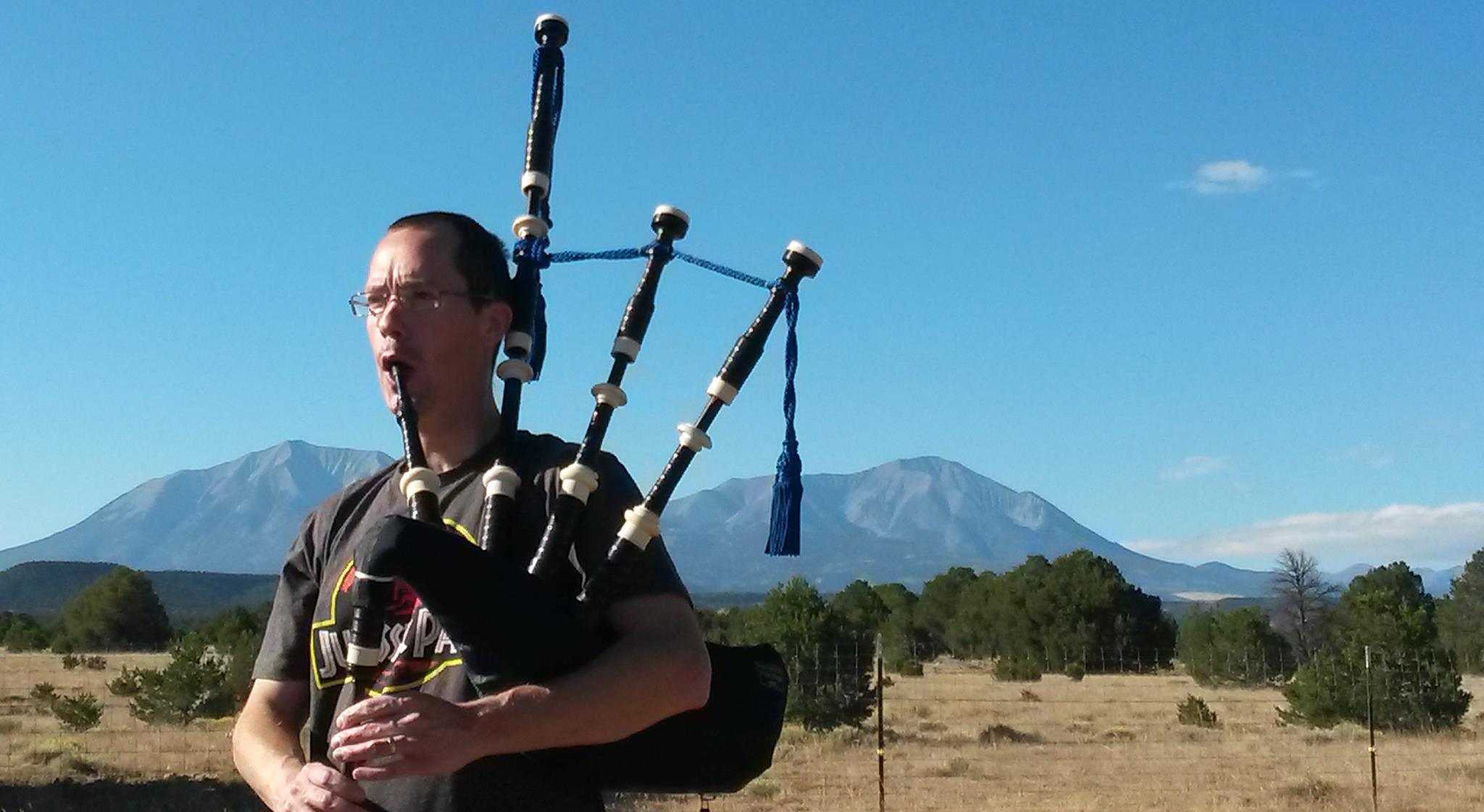
Focal Dystonia (FD) is a condition where one loses control of voluntary muscle movements. It is a condition that is acquired when a task is repetitively done over and over again and is therefore task specific, meaning that it only manifests when one attempts a very specific task. A technical understanding of how it acts boils down to a smearing together of the signals intended for separate parts of the body. For example, in my case, when I aim to play an E grace note with my ring finger, my pinkie contracts violently. Presumably then, the signal to my ring finger instructing it to raise is also getting transmitted to my pinkie but is telling my pinkie to contract, albeit not voluntarily.
Reference: http://www.ncbi.nlm.nih.gov/pmc/articles/PMC1144495/
However, it is not simply the smearing out of nerve signals to nearby fingers, but it also involves the reception of signals by the brain. So, the process of receiving feedback after a signal is sent is also smeared out. Therefore, the entire process of sending a signal from the brain to a muscle, receiving feedback from the muscle, fine tuning the signal and trying again, receive feedback, etc. is seemingly corrupted. This process, sans corruption, is crucial to someone learning a new task. However, FD affects those who have engaged in a specific task repetitively for long periods of time. What is observed is that one gets better and better at the task as it is learned, but at the onset of FD, the ability to do that task diminishes. There have been some genetic and physiological links made in those who suffer from FD, but they are not entirely sufficient for causing FD as not everyone with those conditions exhibits FD. Therefore, FD is something that is self-diagnosed. There is no pain, swelling, or any discrete physiological condition that we can point at and say, that’s the problem we need to fix.
A few videos about FD (courtesy Nathaniel on the Bob Dunsire forums):
- http://www.youtube.com/watch?v=JikRrqix4wU – The example used to introduce FD is that of a pianist who, when faced with playing parts that required extended reaches, found FD to manifest in his 4th and 5th fingers (ring and pinkie), but there was no problem otherwise (again, very task specific). It would seem these two fingers are the most commonly affected. I know of some people whose FD affects the motion of their B finger (ring finger) when moving their low A finger (pinkie). It should be no mystery that I prefer Colin Kyo chanters. These chanters have the smallest finger spread I’ve ever found among highland pipe chanters. I had a 3/4 John Center chanter at one time, ah, I loved that chanter, it was very small. Hand me a pencil, and I’ll finger bagpipe tunes on it all day, no trouble, E grace notes flying everywhere. Of course, my fingers fall right next to each other and are very relaxed. I am not charged with the task of ensuring that holes be adequately covered. I am so very fortunate that in addition to a smaller finger spread, the Colin Kyo chanter is simply a really good chanter with lots of other attributes you can read about in other places on my website/blog. As a side note, I love playing C smallpipe chanters; they’re like playing a pencil, no trouble what so ever finding the holes. Here’s a YouTube video of me wailing away on one and I hit most of the E grace notes! Gotta love these things!
- http://www.youtube.com/watch?v=0hGGjZQed-A – Talks about the smearing of nerve signals and the science behind our understanding.
- http://www.youtube.com/watch?v=JBLHdaSYkxY – Briefly talks about treatment as being retraining of the muscles and appealing to larger muscles further up the arm and not focusing on the forearm and finger muscles. Refining of the motions of the fingers is left until after the larger muscles up higher have been retrained first.
and also this one
Regarding treatment via larger muscle groups and the left hand is that those muscles are engaged in squeezing the bag. How will relearning fine motor skills starting from the back and shoulder muscles (instead of forearm and finger muscles) be affected by heavy use of those muscles in squeezing the bag? What I find interesting is that it is not uncommon on a particularly bad day for my bagpipe to choke when I attempt to play E grace notes, indicating some connection to the larger muscle groups farther up the arm. Whether choking due to bag pressure loss is a manifestation of the FD itself or a side effect of consciously trying to correct the FD, I’m unsure. Perhaps it simply arises from tension in my arm as I anticipate the impending E grace note and I lose focus?
This document from the journal Muscle and Nerve shares some info on FD. See page 558, starting at the top of the right side column. Ultimately, treating FD boils down to coming up with ways of making the brain forget how to send the signal, retraining the signals and muscles, and the like. Injections of Botulinum toxin weren’t necessarily effective among other methods. I was particularly interested in references 21 and 72, although the author of the citing work above indicated not observing the same success as the authors below:
21. Charness ME, Ross MH, Shefner JM. Ulnar neuropathy and dystonic flexion of the fourth and fifth digits: clinical correlation in musicians. Muscle Nerve 1996;19:431–437.
72. Ross MH, Charness ME, Lee D, Logigian EL. Does ulnar neuropathy predispose to focal dystonia? Muscle Nerve 1995; 18:606–611.
My “journey” with FD:
My first bout came while in college. I wasn’t actively playing but one day I got my practice chanter out and my pinkie exhibited this strong contraction when playing E grace notes. Oddly enough, I was able to overcome the problem over the period of a few weeks by simply forcing my pinkie finger to stay erect above the chanter. Several years later in my mid-20s, the problem reappeared and hasn’t resolved itself since (I’m almost 31 at the time of writing). The first fix I tried was again holding my pinkie finger erect. Ultimately, this didn’t work the second go around as the pinkie is still contracting, it just has farther to go. I found the increased tension in my hand often made the problem worse. I also tried taping my pinkie to my ring finger but that ultimately detracts from the performance of the ring finger. I have no trouble playing the note E, the specific task that triggers the dystonia is the call for a rapid E grace note. I did at one time try building a pinkie rest to keep my pinkie erect and that sort of worked. I found it essential to get the pinkie back as far as possible, effectively debilitating it by giving it no leverage. I was so excited I made a couple YouTube videos of me playing with it. It was made of a brass colored clothes hanger so it may be hard to see in the videos due to poor resolution:
MSRHJ number 1, MSRHJ number 2, and some 6/8 marhces.
Musically, being unable to play an E grace note due to the violent contraction of the adjacent pinkie finger wrecked havoc on the musicality of my playing. What effectively happens is a big giant pause as my brain waits for the ring, E finger, to pick up, which it rarely does. Doubling tachums in strathspeys were very square and even, GDE timing suffered severely, taorluaths didn’t happen (don’t even mention crunluaths!), and D doublings amounted to G grace notes. Ultimately, the timing of my tunes suffered as I tried to accommodate the problem and you can hear some of that in the YouTube videos just linked. Furthermore, constantly thinking about the coming E grace note left little time for thinking about phrasing. There were times I toyed with just replacing every E grace note with an F grace note. But then taorluaths sounded really weird, trust me. The next thing I tried was to rest my pinkie on the chanter thinking if I was able to prevent the pinkie from descending below chanter level, at least it wouldn’t be pulling my ring finger down and maybe I could get the E grace note out. This was a great and a terrible idea. It sort of worked, but the tension in my hand still persisted. I’ve spent a great deal of time unlearning the habit of letting my left pinkie touch the chanter. Don’t try it.
One of the easiest cures for the problem was to just totally relax, absolutely and completely. Sort of like playing a pencil. Unfortunately, the overall quality of performance is diminished due to EVERYTHING then sounding rather mushy, something a few E grace notes can’t make up for. It is apparent then, that relaxation or releasing some control over the muscles is essential for retraining the fingers. Over the last couple years I’ve managed to learn to play a taorluath fairly well although it gets sketchy from C to C. I did this by basically relearning how to play it devoid of any knowledge about E grace notes. The piobaireachd dre movement came easily once I played it like an edre, the difference being whether you’re coming from a note below or above E, respectively. Coming from above E, you’re forced to effectively play the big note E on the way down to low A. From a note below E, you play an E grace note to low A; however, I play a full E note just really quickly (again, it’s about how you think about it) and fall back down to A to finish the movement with the F grace note, etc. This has influenced my crunluath playing, as I now play it by playing first a grip followed by this method of playing a dre with a “full E” grace note in the middle. GDE rhythms are coming along and the occasional, very slow D doubling happens every once in a while. Individual E grace notes from, say, C to low A still don’t happen all too reliably. It is still a very forced motion. Come to band practice and watch me play Flett from Flotta and you’ll see my dystonia rear its ugly head with every c{e}A movement. That, or practially the ending of every 2/4 competition march in existence.
As of recently, I’ve had success with returning to keeping my pinkie erect but with less of an effort of keeping it up, but keeping it over my ring finger, as odd as that sounds. Mechanically then as I push up the E ring finger, it physically pushes on the pinkie finger. It’s a bit tricky but seems to work. This is akin to taping the pinkie to the ring except the ring isn’t constrained by the motion or weight of the pinkie.
Other thought processes I’ve experimented with in the past involved simply forcing all grace notes to be large and that also sort of works. In all, the things that work best are the things where I don’t think about the E finger at all, but nothing has been a completely effective cure. You may or may not hear the effects of FD in my playing as distributed via this blog. You certainly only hear the best of the best of my recordings. I record a lot not for distribution specifically, but also to listen to my playing and improve, for critique. More than anything, I can listen to it and sometimes think to myself, “Hey, that was pretty good, I don’t suck as bad as my dystonia (or lack of practice in other areas, haha) makes me feel sometimes.” That is probably its most valuable asset; it provides me the motivation to once again break out the pipes and give it another go knowing full well that I can do this, because I have in the past. There is no encouragement like the struggles you’ve already overcome.
Work in progress….