Category Archives: Great Highland Bagpipe Solo

People playing solo great highland bagpipes.

Ackland Prototype Drone Reeds in the Terry Pipes

I have been testing drone reeds for Terry Ackland for a wee while and I feel his latest reeds are his best yet. These reeds started out VERY bold and the current iteration is just bold, which is good I think. Early versions were incredibly harmonic (and loud) and were fun to play, but unlikely to be adopted due to the sheer imbalance between chanter and drones. So the volume has been dialed back a far bit, so upon listening below you can imagine how loud they initially were. Other recent (using that term loosely here) blog posts of prototype drone reeds would have been older versions of these reeds.

I’m currently testing different tongue widths. I’ve tested both extremes that he recently sent me, I haven’t gotten around to the two middle sizes. Both narrow and wide are incredibly air efficient and rock steady. Due to these two qualities, and despite their harmonic boldness, they are quite easy to tune. They also hold their tuning so the only thing you have to stabilize is your chanter pitch. The wider tongue is less prone to squealing when filling the bag and stopping. These are the wider tongues in the recordings below. The reeds really don’t need a strike to the bag to get started, you can just blow up the bag and they’ll come right in; I strike out of habit.

My entire practice session with the wider tongues was recorded on my iPhone 8 using a Blue Mikey Digital Recorder. It has 3 gain settings: 1) Loud environment 2) Auto-gain 3) Quiet environment. All the recordings were on auto-gain (I think) except the MSR which was recorded with the Loud environment setting (because bagpipes are loud), which resulted in a quieter recording. I usually just use the Blue Mikey as an interface between my iPhone and Zoom H4n Pro recorder through its input jack, but I was lazy today. Although the practice session was broken into 8 pieces, the recorder was going for ALL instances of playing. Tuning, mistakes, etc. are all included. (I just lied, I did omit setting the bridles and initial tuning, but oh well.) There was a gap of time between takes 2 of 3 where I had to retie the middle and outer tenor drone stocks due to a nasty leak that just appeared. Make sure you’re NOT tying bags near the star cut hole, but a bit below! Details of the sets are in the YouTube description field which probably doesn’t appear in the linked videos below, so if you want the tune names head over to YouTube.

G Major Highland Bagpipes

I have yet again revised my G major highland bagpipe setup which involves tuning the drones to low G instead of low A and then retuning the entire chanter. This latest iteration has me running Kron Standard drones (because they’re the flattest AND most accommodating drones), Ross Omega drone reeds (due to their inherent customization) fitted to brass tubing reed extenders, laminate Colin Kyo chanter with some putty in the E and C# holes to tune them correctly to G drones (super flat because E adopts the tuning of the standard F#; the C# actually gets turned into a C natural so it needs putty AND tape), and a Gilmour reed.

I think it would be really grand for a pipe maker to make a version of this chanter where the note we call low G is tuned to concert pitch A 440 Hz. On a nominal modern highland pipe chanter that tunes around 480 Hz, low G would sound around 427 Hz so we really aren’t that far off. All it would really take is bringing low A up to concert pitch B 493.9 Hz (some modern chanters are already here!). The holes would also need to be shifted and resized to accommodate tuning to the G drones in addition to turning the C# into a C natural. But, what really happens by setting low G to A 440 Hz and turning C# into a C natural is you get what pipers would call a G Major chanter, but since it’s tuned to A 440 Hz, every other musician would call it an A Major chanter. This has the distinct advantage of there already being commercially available drone technology to tune drones to an A 440 Hz reference and it opens up a whole host of new repertoire. Yay! I’ve collected some tunes and you can see them on my Free Tunebooks page (G major chanter tunebook). My setup has low A tuning around 464 Hz which means my low G is at 413 Hz which is why it’s so hard to get my drones so flat! So really, I’m just a couple Hz shy of having a G# Major chanter since my low A is so close to Bb 466 Hz.

Here are some shots of the drone reeds and how far out the bass drone has to tune. The tenors are actually down a fair bit.

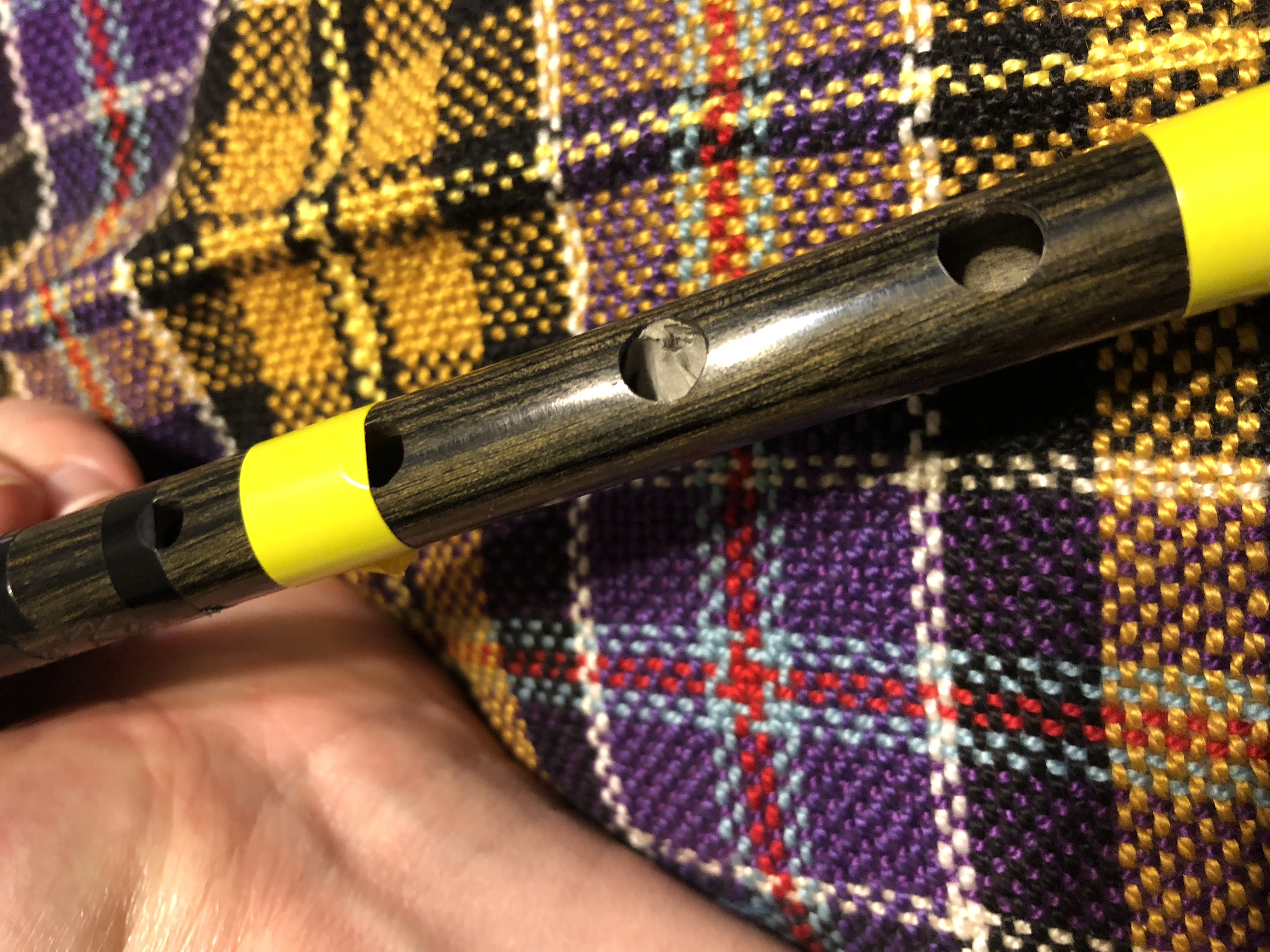
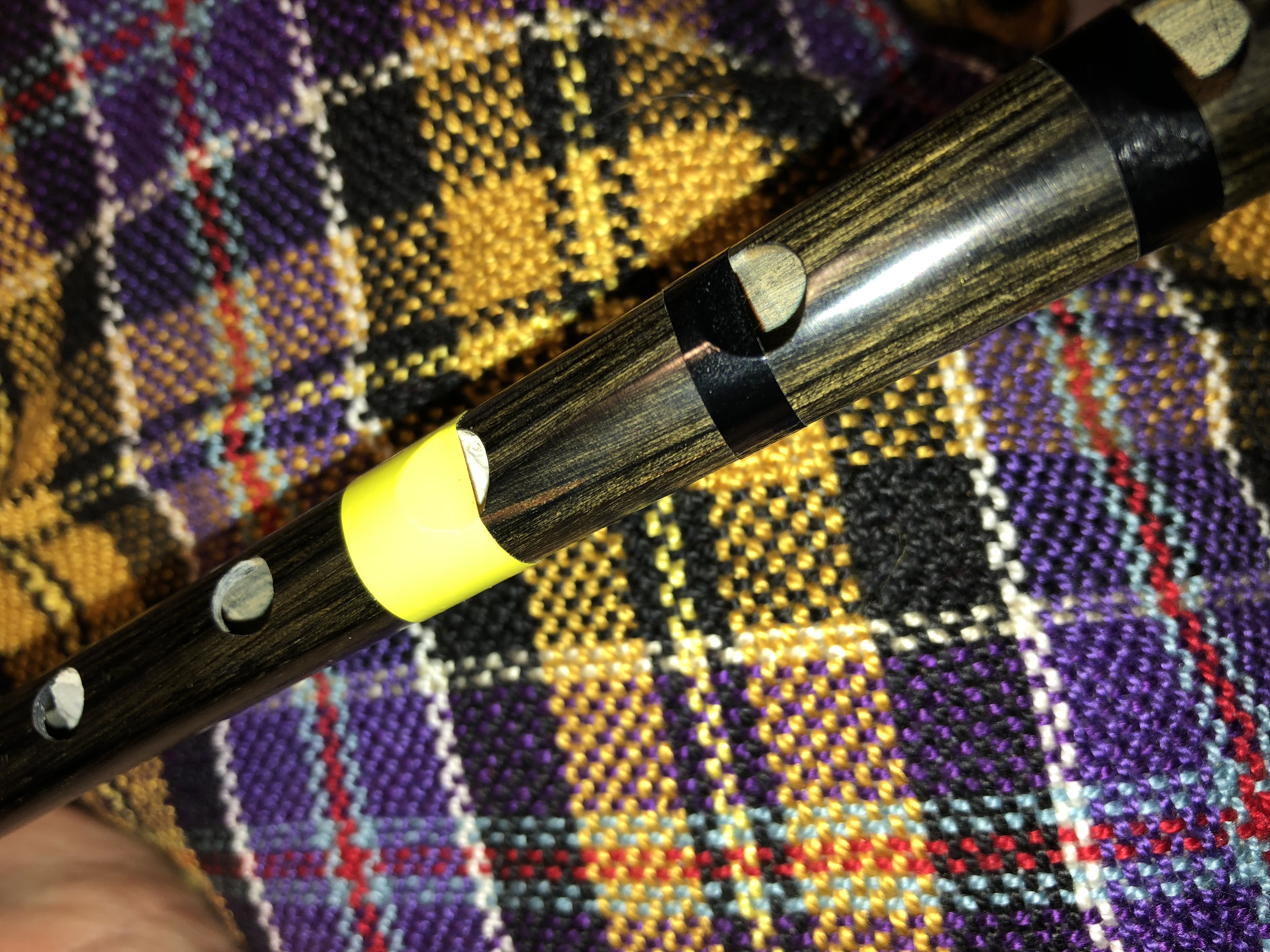
I use sticky putty (the tacky stuff college kids use to stick posters to the wall, Blue-tac or something like that) to flatten the notes that need super flattening because otherwise the holes become so taped over that the sound is greatly muffled. Occluding the chanter bore with putty is much more effective for such drastic changes and doesn’t attenuate the volume as much.

Here’s the E hole:

Here’s the C# hole (yellow tape + putty):

The chanter has two types of tape on it. I usually use automotive pin-striping tape as it holds up against the heat without getting sticky and it leaves no residue. However, the tape is rather thin and so it is not very good for taping large open areas because it can get wavy. The yellow tape is the best electrical tape I’ve found for taping chanters (it comes in black, don’t worry). It is Scotch Vinyl Electrical Tape 35 and I bought my most recent roll (brown) from Home Depot.

In order to post something different than before (mostly non-highland piping tunes that can be heard here and here), I figured I’d play some tunes highland pipers would recognize. My selection criteria were that the tunes focused a lot on low G, high G, B, and D since those harmonize the mostly readily against G drones. Jigs are my bread and butter, so I present to you:

Eileen MacDonald and The Hammer on the Anvil

People like videos so I’ve also posted it to YouTube:

So there’s your highland pipes in G for the day!