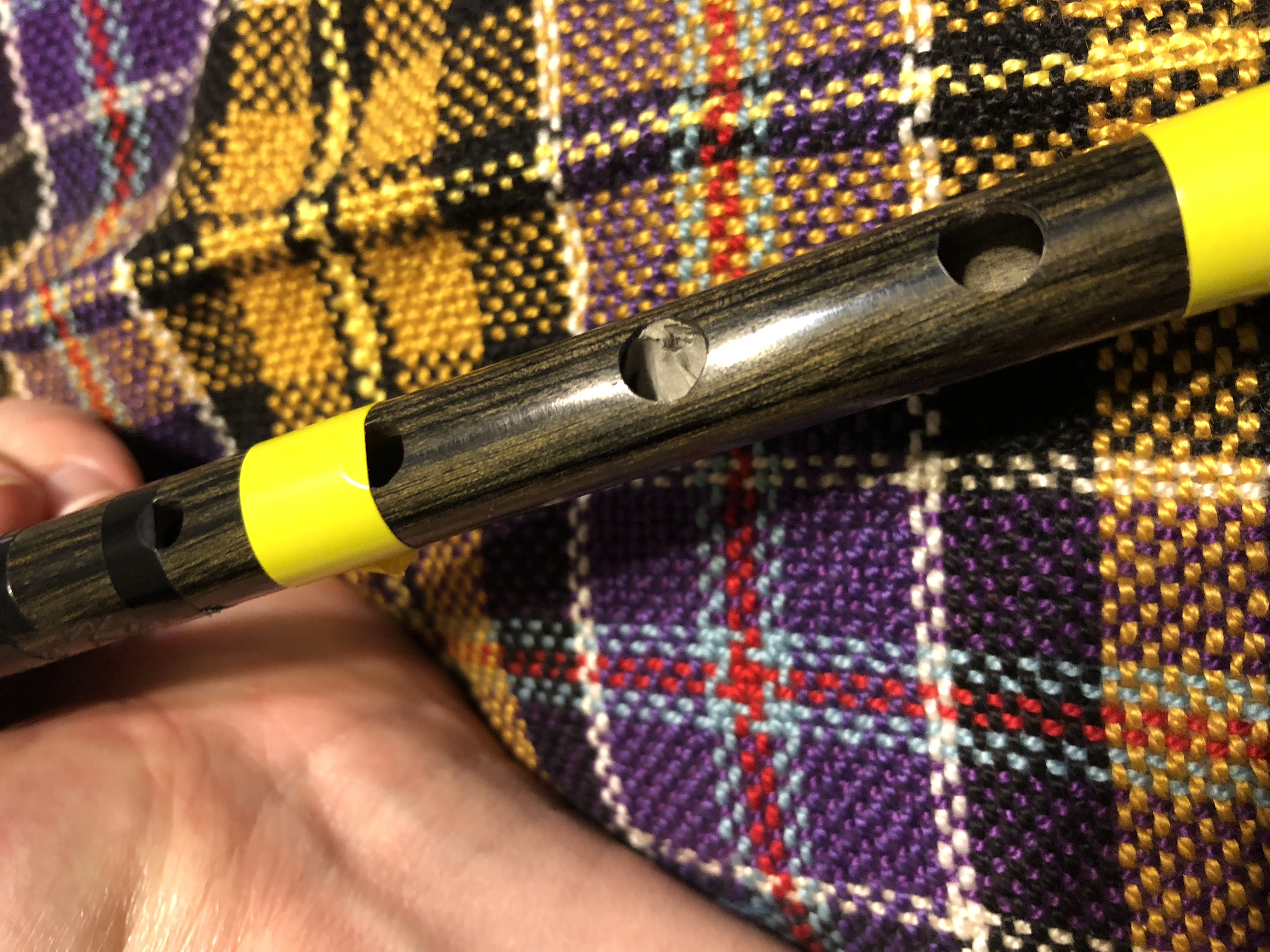
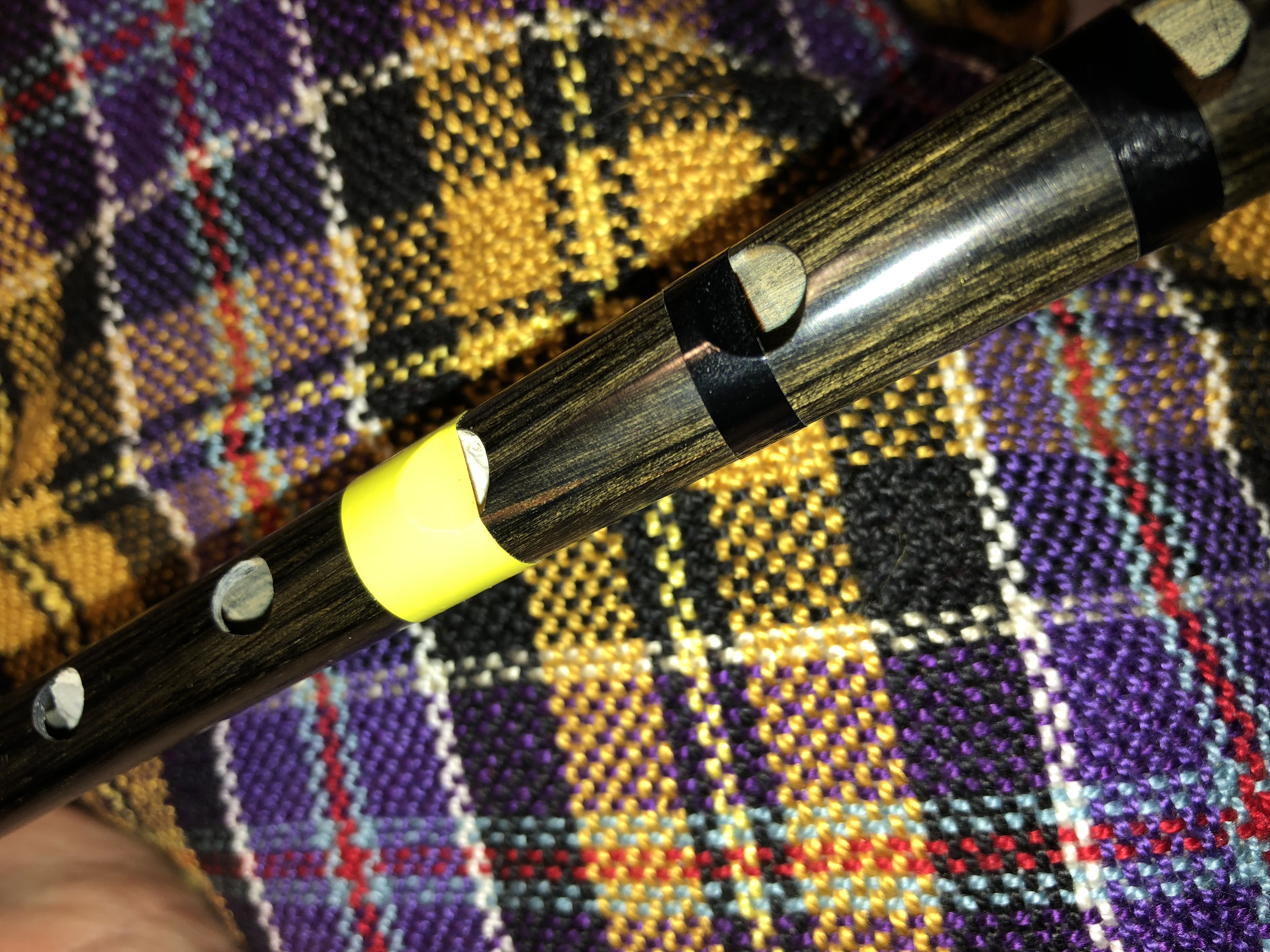
Fixing a sharp high G on an old Sinclair chanter

I have found that drilling out the top fraction of a chanter’s “throat” with a 3/16″ drill bit will flatten sharp high Gs. It will also flatten high A and sharpen F#. So far, it seems important to not drill all the way through the throat as then high G will be way too flat and the F# will become susceptible to collapsing all the way down to F (natural). Leaving 1/4″ to 1/2″ of original bore at the bottom of the chanter throat seems to give the best result.

Most chanter bores that I’ve measured are slightly larger than 5/32″ (0.15625″ = 3.96875 mm) but slightly smaller than 11/64″ (0.171875″ = 4.365625 mm), so my guess is 4.2 mm or thereabouts. Exceptions include the Ayrfire chanter at a full 11/64″ or slightly larger (4.5 mm?), as is an old David Glen chanter I have. The chanter throat is the cylindrical section of the bore between the reed seat and the main conical section where the finger holes are. The chanter throat’s length varies; I’ve measured them from 7/8″ to 1.5″ long.

If one accidentally drills all the way, or just too far, through the chanter throat at 3/16″, you can cut a short length (1/4″ – 1/2″) of 3/16″ OD (outer diameter) K&S Engineering hobby brass or aluminum* (my preference because it is softer and easier to work with) tubing and push it down into the bottom of the chanter throat to reduce the ID (inner diameter) back to “normal” as the wall thickness of their tubing is 0.014″ which puts the ID of the tubing at 3/16″ – 2 x 0.014″ = 0.1595″ = 4.0513 mm.

I’ve have drilled at 3/16″ into a modern chanter (drilled all the way through and then added tubing) and an old Sinclair (didn’t drill all the way through, left 1/4″ original bore at the bottom of the throat), in that chronological order. You can return the chanter to “normal” by inserting a piece of tubing that is the full length of the chanter throat.

Packs of drill bits often come with 5/32″ and 3/16″ bits. You’ll likely have to buy an 11/64″ individually, but it should be available at most hardware stores. However, I found the 11/64″ didn’t change the Sinclair’s throat bore enough to affect the desired flattening, but your results may vary. I did drill out, all the way, a Gibson chanter to 11/64″ with seemingly no ill effects, but also not much high G flattening either. Barely any material was removed as it was one of those bores between 5/32″ and 11/64″. If your chanter has a true 5/32″ bore to start, 11/64″ may be a good place to begin before jumping all the way up to 3/16″. However, 11/64″ OD tubing is not (as readily) available (not made by K&S Engineering anyway) so you couldn’t experiment with added tubing until you jump up to 3/16″.

Here is the video of me experimenting on the Sinclair chanter, trying to see if what I observed when experimenting on my modern chanter also helped fix an old chanter’s VERY sharp high G. It’s not a demonstration of how to do it, it is literally me filming the entire *experiment*, starting with an 11/64″ bit and then going to 3/16″ when that didn’t accomplish much. It’s 55 minutes long. Try this at your own risk.

G Major Highland Bagpipes

I have yet again revised my G major highland bagpipe setup which involves tuning the drones to low G instead of low A and then retuning the entire chanter. This latest iteration has me running Kron Standard drones (because they’re the flattest AND most accommodating drones), Ross Omega drone reeds (due to their inherent customization) fitted to brass tubing reed extenders, laminate Colin Kyo chanter with some putty in the E and C# holes to tune them correctly to G drones (super flat because E adopts the tuning of the standard F#; the C# actually gets turned into a C natural so it needs putty AND tape), and a Gilmour reed.

I think it would be really grand for a pipe maker to make a version of this chanter where the note we call low G is tuned to concert pitch A 440 Hz. On a nominal modern highland pipe chanter that tunes around 480 Hz, low G would sound around 427 Hz so we really aren’t that far off. All it would really take is bringing low A up to concert pitch B 493.9 Hz (some modern chanters are already here!). The holes would also need to be shifted and resized to accommodate tuning to the G drones in addition to turning the C# into a C natural. But, what really happens by setting low G to A 440 Hz and turning C# into a C natural is you get what pipers would call a G Major chanter, but since it’s tuned to A 440 Hz, every other musician would call it an A Major chanter. This has the distinct advantage of there already being commercially available drone technology to tune drones to an A 440 Hz reference and it opens up a whole host of new repertoire. Yay! I’ve collected some tunes and you can see them on my Free Tunebooks page (G major chanter tunebook). My setup has low A tuning around 464 Hz which means my low G is at 413 Hz which is why it’s so hard to get my drones so flat! So really, I’m just a couple Hz shy of having a G# Major chanter since my low A is so close to Bb 466 Hz.

Here are some shots of the drone reeds and how far out the bass drone has to tune. The tenors are actually down a fair bit.

I use sticky putty (the tacky stuff college kids use to stick posters to the wall, Blue-tac or something like that) to flatten the notes that need super flattening because otherwise the holes become so taped over that the sound is greatly muffled. Occluding the chanter bore with putty is much more effective for such drastic changes and doesn’t attenuate the volume as much.

Here’s the E hole:

Here’s the C# hole (yellow tape + putty):

The chanter has two types of tape on it. I usually use automotive pin-striping tape as it holds up against the heat without getting sticky and it leaves no residue. However, the tape is rather thin and so it is not very good for taping large open areas because it can get wavy. The yellow tape is the best electrical tape I’ve found for taping chanters (it comes in black, don’t worry). It is Scotch Vinyl Electrical Tape 35 and I bought my most recent roll (brown) from Home Depot.

In order to post something different than before (mostly non-highland piping tunes that can be heard here and here), I figured I’d play some tunes highland pipers would recognize. My selection criteria were that the tunes focused a lot on low G, high G, B, and D since those harmonize the mostly readily against G drones. Jigs are my bread and butter, so I present to you:

Eileen MacDonald and The Hammer on the Anvil

People like videos so I’ve also posted it to YouTube:

So there’s your highland pipes in G for the day!